
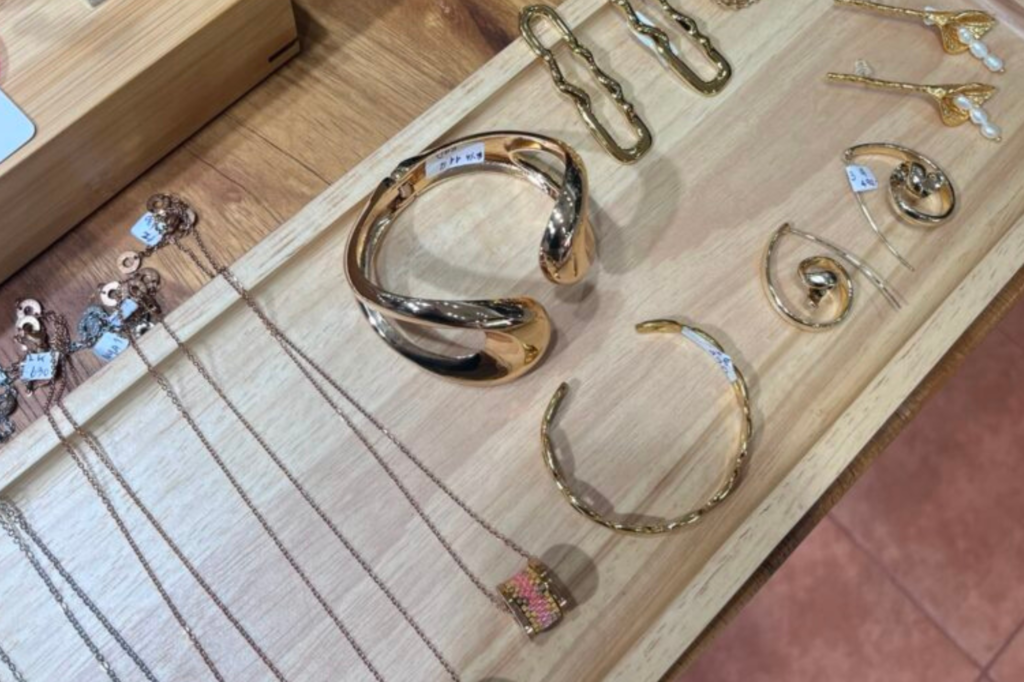
Every ako & sila piece is handpicked from maker workshops across Thailand, Vietnam, Indonesia, and beyond. Here’s what that process actually looks like.
Most fashion jewellery arrives in a shop after passing through several hands — manufacturer, exporter, importer, distributor, retailer. Each layer adds cost and removes proximity to the original making. By the time a piece reaches a customer, it’s been through a chain long enough that the original workshop is invisible.
ako & sila works differently. Every piece in the range is handpicked directly from maker workshops across Asia — no agents, no middlemen, no distribution layers between the source and the shop. That’s a choice that affects everything: the price, the quality control, the range, and what the pieces are.
What handpicked actually means
It means Thierry travels to find pieces rather than ordering from a catalogue. It means sitting in workshops, handling samples, understanding what a maker does well and what doesn’t hold up to daily wear. It means going back to the same workshops when something works and finding new ones when the range needs something different.
This isn’t a romantic version of sourcing — it’s practical. Seeing a piece in a workshop before it reaches the shop is the most reliable form of quality control. A photograph tells you what something looks like. Handling it tells you whether it’ll survive being worn, whether the stone setting is secure, whether the clasp will hold.
Where the pieces come from
The range draws from makers across Thailand, Vietnam, Indonesia, and beyond. Thailand is the home base — Bangkok’s network of workshops and Chatuchak’s community of makers and traders is where the range started and where it’s still deepest. The north of Thailand brings different craft traditions: silverwork, lacquerwork, and materials connected to the hill tribe regions.
Vietnam adds its own character — particularly the north, where lacquer traditions and woodworking produce accessories with a distinctly different aesthetic to Thai pieces. Indonesia, and Bali in particular, contributes craft in silver and natural materials shaped by a deep tradition of jewellery making.
Each region produces something the others don’t. That’s why the range covers nine material categories — because the making traditions that produce them are genuinely different.
No middlemen: what it means for the customer
When sourcing happens without agents or distributors, the cost that would go to those layers stays in the price. At ako & sila’s retail range of THB 490 to 1,590, the pieces represent direct-from-maker value — handmade quality at prices that a conventional supply chain couldn’t offer at the same margin.
For wholesale buyers, the same logic applies. Boutiques and market traders buying from ako & sila are effectively buying at a remove of one from the maker, which is as direct as it gets without sourcing themselves.
What doesn’t make it through
Not everything that’s interesting gets into the range. Pieces that don’t hold up to handling, finishes that wear off too quickly, stone settings that aren’t secure — these don’t make it through the selection process. The range is smaller than the full catalogue of what’s available because the editing is part of the work.
The pieces that do make it are there because someone picked them up, wore them, assessed them, and decided they were worth carrying.
You can read more about the people behind this on our about page, and Sourcing Handmade Jewellery in Southeast Asia looks at the wider regional picture.