
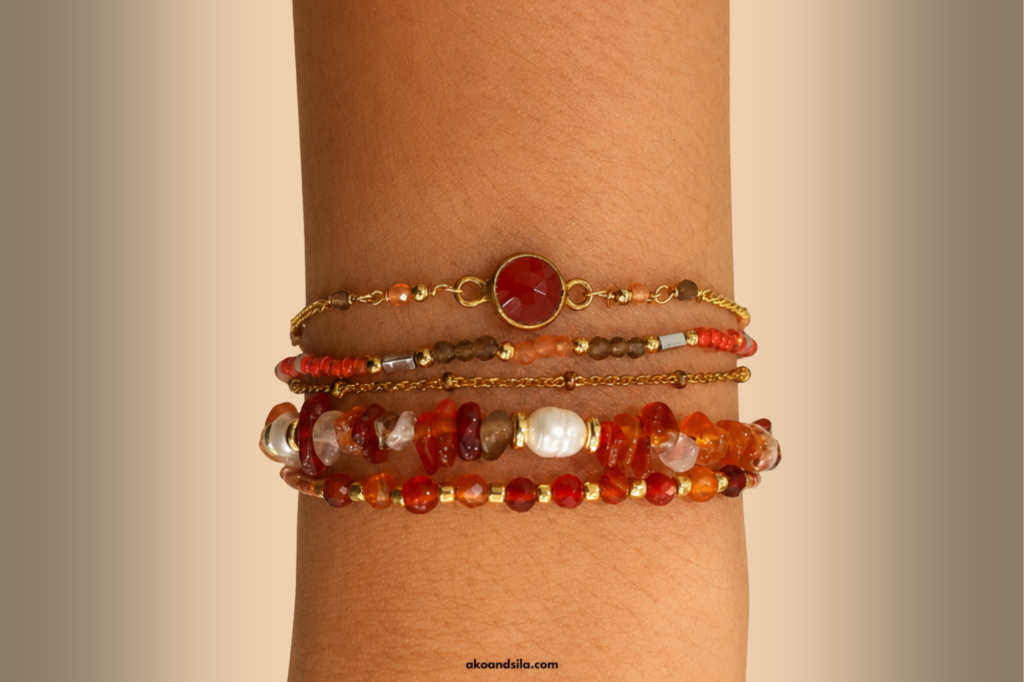
Bracelets have a higher abandonment rate than almost any other jewellery category. People buy them, find they slide off, or pinch, or catch on things, or feel awkward while typing, and eventually stop wearing them. The piece ends up in the dish rather than on the wrist, and next time the same person walks past a bracelet they like, they hesitate — because last time didn’t work.
The reasons bracelets fail are almost always practical, and almost always avoidable.
Size is the starting point
A bracelet that doesn’t fit the wrist correctly won’t stay on, won’t be comfortable, and won’t look right. Most fashion bracelets are made to a standard size — around 18–19cm internal circumference — which suits a medium wrist. If your wrists are slender, a standard-sized bangle will slide around constantly. If your wrists are larger, a rigid bangle may not pass over the hand at all.
For adjustable bracelets and chain styles with clasps, check that the adjustment range covers your actual wrist measurement with a small amount of movement allowed — enough that the bracelet isn’t tight, not so much that it slides to your knuckles.
Rigid versus flexible
Rigid bangles (solid circles of metal) need to fit over the hand to be put on — measure the widest part of your hand when your thumb is tucked in to your palm, which is the narrowest it gets. If a bangle clears that measurement with a small amount of room, it will go on and come off comfortably. If it’s smaller than that, it won’t go on at all.
Chain bracelets with clasps avoid this entirely — they clasp around the wrist regardless of hand size. The trade-off is that clasps can be fiddly to do up one-handed.
For everyday wear: consider what your hands do
A bracelet that catches on keyboards, snagged by a bag strap, or constantly audible while you work is one you’ll take off mid-morning and not put back on. For daily wear, consider weight (lighter is usually easier to forget you’re wearing, which is a good thing), profile (flatter bracelets catch less), and finish (textured or open-work styles catch on fabrics more than smooth ones).
Stacking thin bangles is a common solution — individually lightweight, collectively present, and adjustable by adding or removing pieces depending on the day.
Wearing bracelets on which wrist
Convention says the non-dominant hand, which keeps the dominant hand free. In practice, wear them wherever they’re comfortable and visible to you. There’s no meaningful rule here.
One honest note on watches
If you wear a watch, bracelets on the same wrist tend to scratch both. The opposite wrist is the simpler solution, or a single fine bracelet that sits clearly below the watch on the same arm.
A bracelet worn every day becomes part of the background of your life in a way that more occasional pieces don’t — unnoticed until it’s not there, which is exactly the right relationship to have with a piece of jewellery.
If you land on stacking thin bangles, How to Mix Metals When Wearing Jewellery covers how to combine different tones without it looking accidental, and our bracelets edit has plenty of lightweight pieces suited to daily wear.