
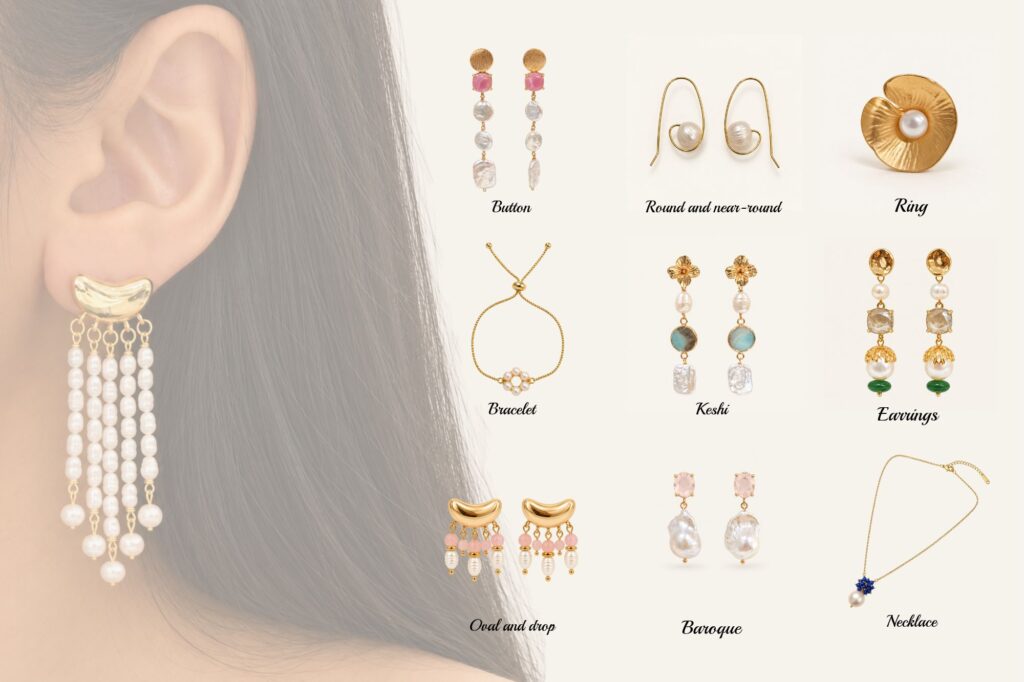
Pearls have a reputation problem. Say the word and most people picture a single strand, a twinset and a grandmother’s jewellery box. That picture is decades out of date. Freshwater pearls are now among the most worn materials in everyday jewellery, and they turn up on hoops, chokers, beaded bracelets and mismatched earrings as often as on classic strands.
They also confuse a lot of people. Is it real? Why is it not completely round? Why does one pair cost ฿300 and another ten times that? This guide answers those questions plainly, so you know what you’re holding before you buy.
How a freshwater pearl forms
A pearl grows inside a mollusc. When something irritates the soft tissue, the animal coats it in layer after layer of nacre, the same material that lines the inside of the shell. Over months and years those layers build up into a pearl.
Freshwater pearls grow in mussels farmed in lakes, ponds and rivers. Saltwater pearls, such as Akoya or South Sea pearls, grow in oysters in the sea. Nearly all pearls sold today, freshwater and saltwater alike, are cultured. That means a farmer starts the process on purpose rather than waiting for chance. A cultured pearl is still a real pearl. The animal still does all the work.
One mussel can grow many pearls at a time, while a saltwater oyster usually grows one or two. That is the main reason freshwater pearls cost far less. It has nothing to do with whether they are genuine.
Real pearl, shell pearl or glass pearl?
Three very different things get called pearls in shops and online listings.
• Freshwater pearls are grown inside a mussel. Every one is slightly different in shape, size and surface.
• Shell pearls are made from ground or carved shell, shaped into a bead and coated to look like a pearl. They are completely uniform and heavier than you expect.
• Glass or plastic pearls are beads with a pearly coating. They are light, very round and identical to each other.
There are a few easy ways to tell them apart. Look at a strand or a pair closely. Real freshwater pearls never match exactly, and you’ll see small dimples, rings or tiny marks on the surface. Rub two pearls gently against your front teeth. Real nacre feels slightly gritty, while coated beads feel smooth and slippery. Check the drill hole too. On a coated bead the coating often chips or peels around the hole.
Every pearl piece we sell at ako & sila is a freshwater pearl. Our team makes them by hand in our workshop in On Nut, Bangkok, and you can read more about that on our handmade jewellery page.
Why most freshwater pearls aren’t round
A truly round pearl is rare in any farm. Most pearls grow into other shapes, and those shapes have names worth knowing.
• Round and near-round. The classic look. Hardest to find, so usually the most expensive.
• Button. Flat on one side and domed on the other. Popular for studs, because the flat back sits close to the ear.
• Oval and drop. Longer than they are wide. Drops hang well from a hook or a hoop.
• Baroque. Irregular and lumpy, with no two the same. Baroque pearls have become the favourite of anyone who wants pearls to feel modern rather than formal.
• Keshi. Small, flat, petal-like pearls with a very bright lustre.
There is no right shape. A round pearl reads as classic and polished. A baroque pearl reads as relaxed and a bit unexpected. Pick the one that suits the way you dress.
What makes one pearl better than another
When jewellers judge pearls they look at five things. You don’t need a loupe to use them.
• Lustre. How sharply the surface reflects light. Hold the pearl under a lamp. A good one shows a crisp reflection, not a dull glow.
• Surface. Fewer marks mean a higher grade, though small marks are normal and prove the pearl grew naturally.
• Shape. The closer to round, the rarer it is, as explained above.
• Size. Measured in millimetres across. Bigger pearls take longer to grow.
• Colour. Freshwater pearls grow naturally in white, cream, peach, pink and lavender. Darker shades such as grey or black are usually dyed, which is fine as long as it’s honest.
For everyday fashion jewellery, lustre matters most. A pearl with good lustre looks bright and alive even when it’s small and irregular.
How to wear freshwater pearls now
The easiest way to make pearls feel current is to pair them with something that isn’t precious. Try a single baroque pearl drop on a gold-tone hoop. Put a pearl bracelet next to a beaded one. Wear small pearl studs with a T-shirt and jeans.
Mixing is the point. One pearl earring with a plain hoop on the other ear looks deliberate, not accidental. A pearl choker over a knitted jumper takes the formality out of it straight away. If you want ideas, browse our pearl earrings and pearl bracelets. Online, our pearl pieces start at around US$12.
Caring for freshwater pearls
Nacre is softer than most materials in your jewellery box, so pearls need a bit of attention. Follow a few simple habits.
1. Put them on last. Perfume, hairspray and sunscreen dull the surface over time.
2. Take them off first. Remove pearls before swimming, showering or exercising.
3. Wipe them after wearing with a soft, dry cloth to remove sweat and skin oils.
4. Store them apart from other jewellery in a soft pouch, so harder pieces don’t scratch them.
5. Don’t seal them in plastic for months. Pearls contain a little water and can dry out.
Bangkok’s heat makes the second habit important. Sweat is mildly acidic, and on a 35-degree day it does more damage than anything else.